The Closing Itself
How Are Property Taxes Prorated at a Florida Closing?
Direct answer
Property tax proration at a Florida closing splits the current year's taxes by the days each party owns the home. Florida taxes are billed in November for the whole calendar year, so before the bill is paid the seller usually credits the buyer for the seller's share. The contract sets the method; the title company does the math.
Key takeaways
- Florida real property is assessed as of January 1 under section 192.042, and taxes are a first lien from January 1 of the year they are levied under section 197.122.
- Taxes are due November 1, or as soon after as the certified roll reaches the tax collector, and become delinquent April 1 of the following year under section 197.333.
- Because the bill arrives late in the year, a seller who closes before paying it usually credits the buyer for the seller's days; after the seller pays it, the buyer usually reimburses the seller for the rest of the year.
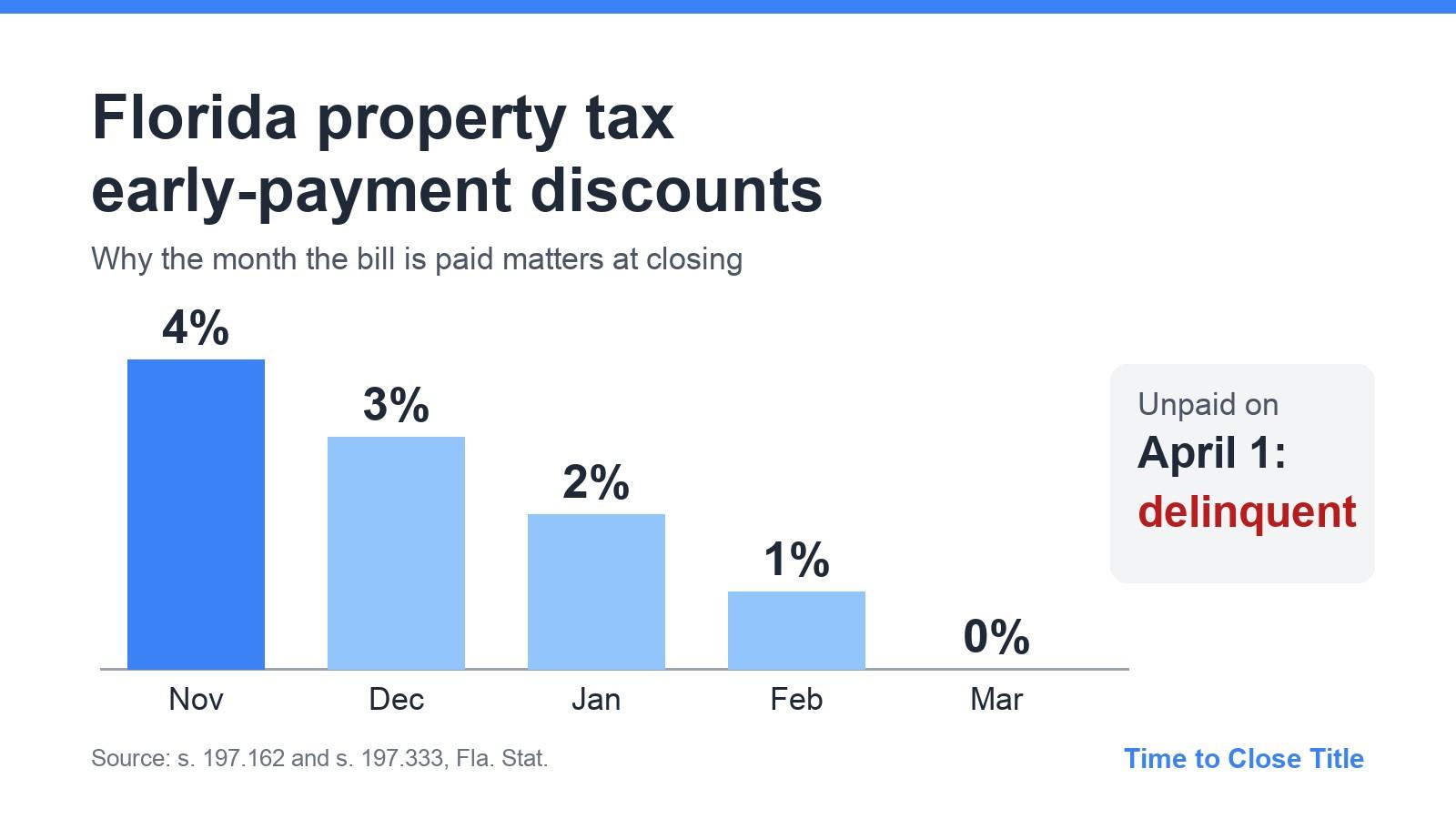
- Section 197.162 gives discounts of 4 percent in November, 3 percent in December, 2 percent in January, 1 percent in February, and none in March, which is why the contract's proration terms matter.
- The proration is based on this year's bill, not the buyer's future bill, which can rise after a change of ownership resets the assessment under section 193.155(3).
- This article is general information, not legal or tax advice. Read your own contract, and talk to a Florida real estate attorney or tax professional about your situation.
How are property taxes prorated at a Florida closing?
By days of ownership. Florida property taxes are levied for a calendar year, and the closing splits that year's bill between the seller, who owned the home from January 1 to closing, and the buyer, who owns it after. The split appears as a credit or debit on the settlement statement.
The timing explains why a split is needed at all. Under section 192.042, Florida Statutes, real property is assessed according to its just value on January 1 of each year. Under section 197.333, the taxes are due November 1, or as soon after as the certified tax roll reaches the tax collector, and become delinquent on April 1 of the following year or 60 days after the original notice is mailed, whichever is later.
So for most of the year, the current year's taxes exist as a lien but not yet as a bill. Under section 197.122, taxes are a first lien, superior to all other liens, from January 1 of the year they are levied until they are paid. The buyer takes the home subject to that lien, so the seller's share has to be settled at closing.
How the split is calculated, including which day counts for whom and which figure is used before the bill exists, comes from the sales contract. We follow the contract. We do not choose a method the contract does not state.
| Date | What happens | Source |
|---|---|---|
| January 1 | Real property is assessed at just value for the year | s. 192.042 |
| January 1 | That year's taxes become a first lien on the property | s. 197.122 |
| November 1 | Taxes are due, or as soon after as the certified roll reaches the tax collector | s. 197.333 |
| November to February | Early-payment discounts of 4, 3, 2, and 1 percent | s. 197.162 |
| April 1 (following year) | Unpaid taxes become delinquent, or 60 days after the notice is mailed if later | s. 197.333 |
Why does the Florida seller usually give the buyer a tax credit?
Because Florida taxes are paid in arrears. A home that closes in, say, July has a tax bill for the whole year that will not be mailed until November, after the seller is gone. The buyer will pay that bill, so the seller credits the buyer at closing for the days the seller owned the home.
The math is simple once the contract supplies the inputs. Here is a hypothetical example, not a quote: a home with an estimated annual tax of $3,650 works out to $10 per day. If the contract charges the seller through the day before a July 1 closing, the seller owned the home 181 days in 2026, and the seller credits the buyer $1,810.
Before the November bill exists, the figure has to be estimated. The contract should say which figure to use, such as a current or prior year's tax, and how discounts and exemptions are treated. Whether either side can ask for a re-proration once the real bill arrives also depends on the contract. Read that paragraph of your contract before closing, and ask your agent or attorney if it is unclear.
$3,650
Estimated annual tax (hypothetical)
$10
Per day over 365 days
181
Seller's days, January 1 through June 30
$1,810
Seller's credit to the buyer
What changes if the Florida closing happens after the tax bill comes out?
Two things: there is a real number, and someone may already have paid it. If the seller paid the current year's bill in November or December, the seller has paid for days the buyer will own. The proration then usually runs the other way, with the buyer reimbursing the seller for the rest of the year.
If the bill is out but unpaid, it is usually paid at closing from the seller's proceeds, with the buyer's share handled as the contract directs. A closing between January and March may also find the prior year's bill still open. That bill is a lien under section 197.122 and is normally paid in full at closing, since it becomes delinquent on April 1 under section 197.333.
The month the bill is paid changes the amount. Under section 197.162, payments earn a discount of 4 percent in November or within 30 days after the original notice is sent, 3 percent in December, 2 percent in January, 1 percent in February, and zero in March. The Hernando County Tax Collector lists the same schedule and a March 31 deadline before taxes become delinquent on April 1.
Whether the proration uses the gross bill or the discounted amount is a contract question. A seller who misses the discount does not automatically shift that cost to the buyer, and a buyer is not owed a discount the contract does not give.
4%
November
3%
December
2%
January
1%
February
0%
March
What if the Florida seller pays property taxes in installments?
Then part of the year may already be paid before the bill is final. Under section 197.222, a taxpayer whose taxes are estimated at more than $100 may apply by April 30 to prepay in four installments based on the prior year's actual taxes.
The schedule is one quarter by June 30 with a 6 percent discount, one quarter by September 30 with a 4.5 percent discount, one quarter plus half of any adjustment by December 31 with a 3 percent discount, and the last quarter plus the rest of any adjustment by March 31 with no discount.
If the seller is on the plan, tell the title company early. The installments already paid count toward the year's tax, so the proration has to account for them, and the buyer should know whether the remaining installments will come to them. We confirm what was paid with the tax collector. We do not guess at installment balances.
Will the closing proration match the Florida buyer's next tax bill?
Often not, and that is the most common surprise. The proration splits this year's bill, which reflects the seller's assessment and exemptions. Under section 193.155(3), homestead property is reassessed at just value as of January 1 of the year after a change of ownership, so the Save Our Homes cap the seller built up does not carry over.
The seller's homestead exemption does not transfer either. A buyer who will live in the home applies with the county property appraiser, as covered in when to apply for the Florida homestead exemption after closing. The property tax disclosure summary required by section 689.261 warns buyers about exactly this gap.
A buyer with an escrowed mortgage may see the lender collect an initial tax deposit at closing on top of the proration. That deposit is the lender's requirement, shown on the Closing Disclosure; it is not part of the buyer-seller split.
What does the title company check about property taxes before a Florida closing?
The tax status of the parcel, not just the proration. Unpaid taxes are a first lien, and a title search looks for open current and prior-year taxes, as our guide to what a Florida title search finds explains. Delinquent taxes left long enough lead to tax certificates and, eventually, a tax deed sale.
For a home in Hernando County, we pull the parcel's status from the county tax collector, apply the contract's proration terms, and show the result on the settlement statement for both sides to review. After the deed is recorded, the Hernando tax collector's site notes that the property appraiser updates the owner on the tax roll, and a seller who still receives a bill should forward it to the new owner.
We do not set the tax amount, calculate penalties, or decide what the contract means. The tax collector sets the bill, the contract sets the split, and a Florida real estate attorney answers questions about the contract.
Read the contract's proration terms
The sales contract sets the proration method, the figure used before the bill exists, and how discounts and exemptions are treated.
Check the parcel's tax status
The title company confirms with the county tax collector whether current or prior-year taxes, or installments, are paid or open.
Pay any open prior-year taxes
Taxes are a first lien under section 197.122, so open prior-year taxes are normally paid at closing, usually from the seller's proceeds.
Calculate the proration
The current year's tax is split by days of ownership and shown as a credit or debit on the settlement statement.
Watch for the next bill
After closing, the buyer pays the November bill and applies for any homestead exemption with the property appraiser.
Frequently asked questions
Does the buyer or seller pay Florida property taxes for the year of closing?
Both, by days of ownership. The current year's taxes are prorated on the settlement statement as the contract directs. Because the bill is not due until November under section 197.333, the seller usually credits the buyer for the seller's share if the bill has not been paid.
Are Florida property taxes paid in arrears?
Yes. Property is assessed as of January 1 under section 192.042, but the bill for that year is due November 1 or as soon after as the certified roll reaches the tax collector, and is not delinquent until April 1 of the next year.
What happens if the prior year's Florida taxes are unpaid at closing?
They are a first lien under section 197.122, so the title company normally requires them to be paid at closing, usually from the seller's proceeds. Unpaid taxes become delinquent April 1 under section 197.333.
Is the November discount included in the Florida tax proration?
It depends on the contract. Section 197.162 sets discounts of 4 percent in November down to zero in March, and the contract decides whether the proration uses the discounted amount, the gross bill, or another figure.
Why is my first Florida tax bill higher than the proration?
The proration is based on the seller's bill. Under section 193.155(3), homestead property is reassessed at just value on January 1 of the year after a change of ownership, and the seller's exemptions do not transfer to the buyer.