Deed Guides
What Does Florida Require on a Deed: Two Witnesses and a Notary?
Direct answer
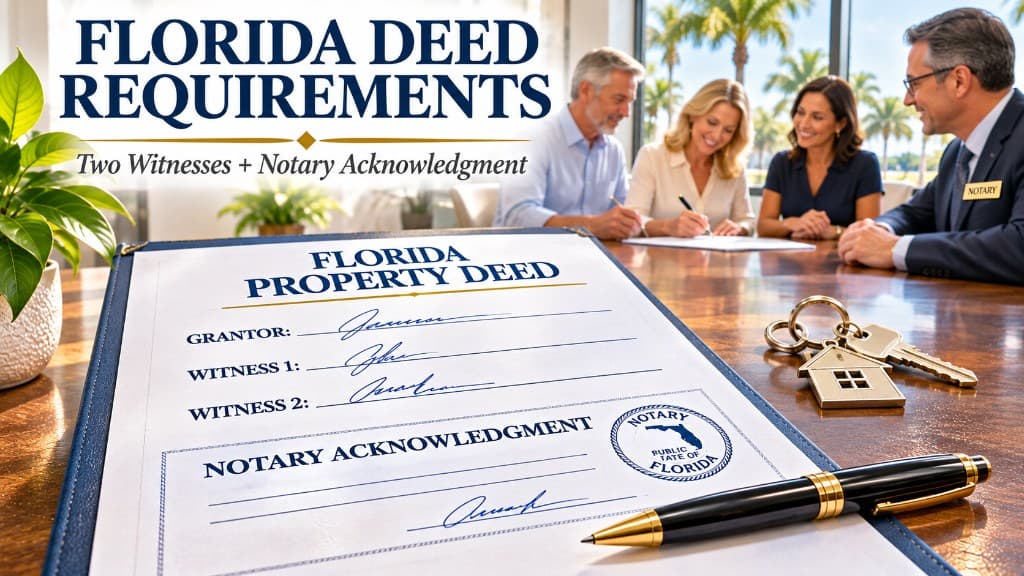
A Florida deed that conveys a freehold, or a term of more than one year, has to be in writing and signed by the grantor, or the grantor's authorized agent, in the presence of two subscribing witnesses. That is Florida Statutes section 689.01. A lease does not need those witnesses, and no seal is required. The notary is a different step. Section 695.03 says an instrument concerning real property is entitled to be recorded when the execution is acknowledged by the signer, proved by a subscribing witness, or otherwise authenticated. A notary certificate by itself is not the second witness. A person who sees the grantor sign may also sign as a witness and notarize the grantor's signature, if the certificate names that signature and the notary does not notarize the notary's own signature. Time to Close Title prepares the deed. At a signing we arrange, the grantor signs before two witnesses and a notary. On a deed we only prepare, the client records it. The Spring Hill office is not the clerk.
Key takeaways
- Section 689.01 requires two subscribing witnesses on a deed of a freehold or a term of more than one year. A lease does not.
- The witnesses are present when the grantor signs. For an electronic signature, section 689.01(2) allows presence by audio-video.
- Section 695.03 is the recording step. An acknowledgment or a proof entitles the deed to be recorded. The notary block alone is not the second witness.
- Section 695.26 requires printed names and post-office addresses, and a 3-inch by 3-inch space for the clerk on the first page.
- Homestead joinder is a separate signature. Two witnesses do not replace a spouse who must join.
- We prepare the deed. The client records a deed we only prepare.
What does Florida require on a deed?
Florida splits the signing into two jobs. Section 689.01 is what makes the conveyance. The grantor, or the grantor's lawfully authorized agent, signs a written instrument in the presence of two subscribing witnesses. That section covers a freehold and a term of more than one year. It says no subscribing witnesses are required for a lease, and no seal is necessary.
Section 695.03 is what entitles the instrument to be recorded. The execution must be acknowledged by the party, proved by a subscribing witness, or legalized or authenticated in a form that section lists. Inside Florida, a notary public of this state may take that acknowledgment or proof. A warranty deed and a quitclaim deed both go through these two steps. Read warranty deed versus quitclaim deed and what a Florida quitclaim deed does. The deed type does not drop the witnesses.
A notary certificate with no witness signatures does not satisfy section 689.01. Two witness signatures with no acknowledgment or proof do not satisfy section 695.03. Time to Close Title prepares the deed so both are on the instrument. We do not send a deed to the clerk and hope a missing signature is overlooked.
| Two subscribing witnesses | Notary acknowledgment or proof | |
|---|---|---|
| Statute | Section 689.01. The conveyance of a freehold, or a term of more than one year. | Section 695.03. What entitles the instrument to be recorded. |
| Who signs | Two witnesses who subscribe the deed. They are present when the grantor signs. | A notary, or another officer section 695.03 lists, takes the acknowledgment or a proof. |
| What does not count | A notary block with no subscribing-witness signature. | Witness signatures with no acknowledgment and no proof. |
| A lease | Section 689.01 says a lease does not need subscribing witnesses. | Recording a lease is a different instrument. This page is about a deed. |
Who can be a witness, and what does the notary actually do?
A subscribing witness signs the deed because that person was present when the grantor signed. The grantor is not one of those two witnesses. We do not use the grantee as a witness. The witness's name is printed under the signature, with a post-office address. That printing is a recording rule under section 695.26, covered below.
The notary's job under section 695.03 is the acknowledgment or the proof, not a substitute for the second witness. A person who only signs the notary certificate did not, by that certificate, become a subscribing witness. A person who sees the grantor sign may sign as one witness and also notarize the grantor's signature. The certificate has to name the grantor's signature. The notary does not notarize the notary's own signature. At a signing we arrange, the grantor signs before two witnesses and a notary, and the grantor brings government-issued photo ID.
For an electronic signature, section 689.01(2) says the two-witness requirement may be satisfied by witnesses present and electronically signing by audio-video communication technology, as defined in section 117.201. The witness is in the physical presence of the principal, or present through that technology, when the principal affixes the electronic signature, and the witness hears the principal acknowledge that the principal has signed the electronic record. Section 689.01(3) validates witnessing done in that manner. It does not bar a challenge based on fraud, forgery, impersonation, duress, incapacity, or undue influence. A casual video call is not that statute. Read who attends a Florida closing. Some loan packages still require wet ink. We do not decide that a remote signing is allowed on a file the lender has not approved.
Two witnesses
Section 689.01. Present at the signing, or by audio-video when the signature is electronic.
Acknowledgment
Section 695.03. That is what entitles the deed to be recorded. The notary block alone is not the second witness.
Not the grantee
The grantor is not a witness to the grantor's own signature. We do not use the grantee as a witness.
What else has to be on the deed before the clerk will take it?
Section 695.26 says the clerk of the circuit court shall not record an instrument conveying an interest in real property unless the names of each signer and each witness are printed immediately beneath those signatures, with post-office addresses, the preparer's name and post-office address are on the instrument, the notary's name is printed beneath the notary's signature, and a 3-inch by 3-inch space at the top right of the first page is reserved for the clerk, with a 1-inch by 3-inch space on each later page. On a deed, each grantee's name and post-office address go on the instrument. Subsection (2) lets the clerk accept a name or address in another position when the connection is apparent. Subsection (3) says the section does not apply to an instrument executed, acknowledged, or proved outside this state. We still prepare the deed from the last recorded legal description. We do not decide that an out-of-state signing skipped the Florida form.
Two witnesses do not replace a spouse. If the house is homestead, the spouse generally must join the deed even when that spouse is not the grantor on the last deed. Read why a Florida homestead spouse must sign. A power of attorney is a different signer. The agent signs in the presence of the two witnesses, and the document has to grant that deed. Read power of attorney at a Florida closing. This page does not retell that grant.
A missing witness is not a scrivener error. Read what a Florida corrective deed is. We do not relabel an unwitnessed deed as a correction. The grantor signs an instrument that meets section 689.01. A Lady Bird deed and a life estate deed are still deeds. Read a Florida life estate and a Lady Bird deed. Documentary stamp tax is its own article. Read how Florida documentary stamp tax works on a deed. We quote the stamp tax on the file. We do not invent a clerk fee.
How do you get the deed signed and recorded?
Bring the last recorded deed so the legal description matches, and bring government-issued photo ID. A street address is not the legal description. Tell us who is signing and whether the house is homestead. We prepare the deed. We can arrange the two witnesses and the notary.
On a deed we only prepare, the client records it with the clerk of the county where the land sits and pays the documentary stamp tax and the clerk fee. On a sale we close, we submit the deed after good funds. Read what gets recorded after a Florida closing. Confirm any wire by calling (352) 792-1214. Do not use an account number that arrived only by email.
The office is at 3087 Anderson Snow Road, Spring Hill, FL 34609. Call (352) 792-1214 or toll-free 888-228-0555. Email info@TimetoCloseTitle.com. Hours are Monday through Friday, 9:00 AM to 5:00 PM. Hernando Official Records are in Brooksville. Pasco records are in Dade City and New Port Richey. Citrus records are in Inverness. See the Hernando County page and Pasco and Citrus closings from Spring Hill. The Spring Hill office is not the clerk. Contact the office.
Bring the last deed and photo ID
The legal description comes from the last recorded deed. A street address is not the legal description. The grantor brings government-issued photo ID. Tell us whether the house is homestead and whether an agent will sign under a power of attorney.
We prepare the deed with the recording lines
Section 695.26 calls for each signer's and each witness's printed name and post-office address, the preparer's name and address, the notary's printed name, each grantee's name and address, and the clerk's 3-inch by 3-inch space on the first page. We prepare that deed. We do not invent the documentary stamp tax or the clerk fee.
The grantor signs before two witnesses
Section 689.01 requires two subscribing witnesses for a freehold, or a term of more than one year. A lease does not need them. The grantor is not one of the witnesses. We do not use the grantee as a witness. For an electronic signature, section 689.01(2) allows witnesses by audio-video. A casual video call is not that statute.
A notary takes the acknowledgment
Section 695.03 is what entitles the deed to be recorded. The notary certificate alone is not the second witness. A person who sees the grantor sign may also sign as a witness and notarize the grantor's signature, if the certificate names that signature and the notary does not notarize the notary's own signature. At a signing we arrange, the grantor signs before two witnesses and a notary. If the house is homestead, the spouse generally joins.
The client records a deed we only prepare
On a deed we only prepare, the client records it with the clerk of the county where the land sits and pays the documentary stamp tax and the clerk fee. On a sale we close, we submit the deed after good funds. Confirm any wire by calling (352) 792-1214. Hernando Official Records are in Brooksville. The Spring Hill office is not the clerk.
Frequently asked questions
Does a Florida deed need two witnesses?
Yes, when the deed conveys a freehold or a term of more than one year. Section 689.01 requires the grantor, or the grantor's authorized agent, to sign in the presence of two subscribing witnesses. The same section says a lease does not need subscribing witnesses, and no seal is required. A warranty deed and a quitclaim deed both need the witnesses. Read what a Florida quitclaim deed does.
Does the notary count as one of the two witnesses on a Florida deed?
Not by the notary certificate alone. Section 695.03 is the acknowledgment or proof that entitles the deed to be recorded. A person who sees the grantor sign may also sign as a witness and notarize the grantor's signature, if the certificate names that signature and the notary does not notarize the notary's own signature. At a signing we arrange, the grantor signs before two witnesses and a notary.
Can Florida deed witnesses sign by video?
Section 689.01(2) allows witnesses to be present and electronically sign by audio-video communication technology, as defined in section 117.201, when the signature is electronic. The witness must hear the principal acknowledge that the principal has signed the electronic record. Section 689.01(3) does not bar a challenge for fraud, forgery, or incapacity. A casual video call is not that statute. Read who attends a Florida closing. Some loan packages still require wet ink.
Does a spouse still have to sign a Florida deed if there are two witnesses?
Yes, when homestead joinder applies. Two witnesses do not replace the spouse. If the house is homestead, the spouse generally must join the deed even when that spouse is not the grantor on the last deed. Read why a Florida homestead spouse must sign.
What has to be printed on a Florida deed before the clerk records it?
Section 695.26 requires printed names and post-office addresses for the signers and the witnesses, the preparer's name and address, the notary's printed name, each grantee's name and address on a deed, and a 3-inch by 3-inch space at the top right of the first page for the clerk. The clerk may accept a name or address in another position when the connection is apparent. We prepare those lines. We do not invent the clerk fee.
Can a corrective deed fix a Florida deed that was missing a witness?
No. A missing witness is not a scrivener error on an otherwise complete deed. Read what a Florida corrective deed is. The grantor signs an instrument that meets section 689.01. We do not relabel an unwitnessed deed as a correction.
Who records the deed after the witnesses and the notary sign?
On a deed we only prepare, the client records it with the clerk of the county where the land sits and pays the documentary stamp tax and the clerk fee. On a sale we close, we submit the deed after good funds. Read what gets recorded after a Florida closing. Confirm a wire by calling (352) 792-1214. The office is at 3087 Anderson Snow Road, Spring Hill, FL 34609. Call (352) 792-1214 or toll-free 888-228-0555. Email info@TimetoCloseTitle.com. Hours are Monday through Friday, 9:00 AM to 5:00 PM. Hernando Official Records are in Brooksville. The Spring Hill office is not the clerk. Contact the office.