Deed Guides
Can a Guardian Sell a Florida Home?
Direct answer
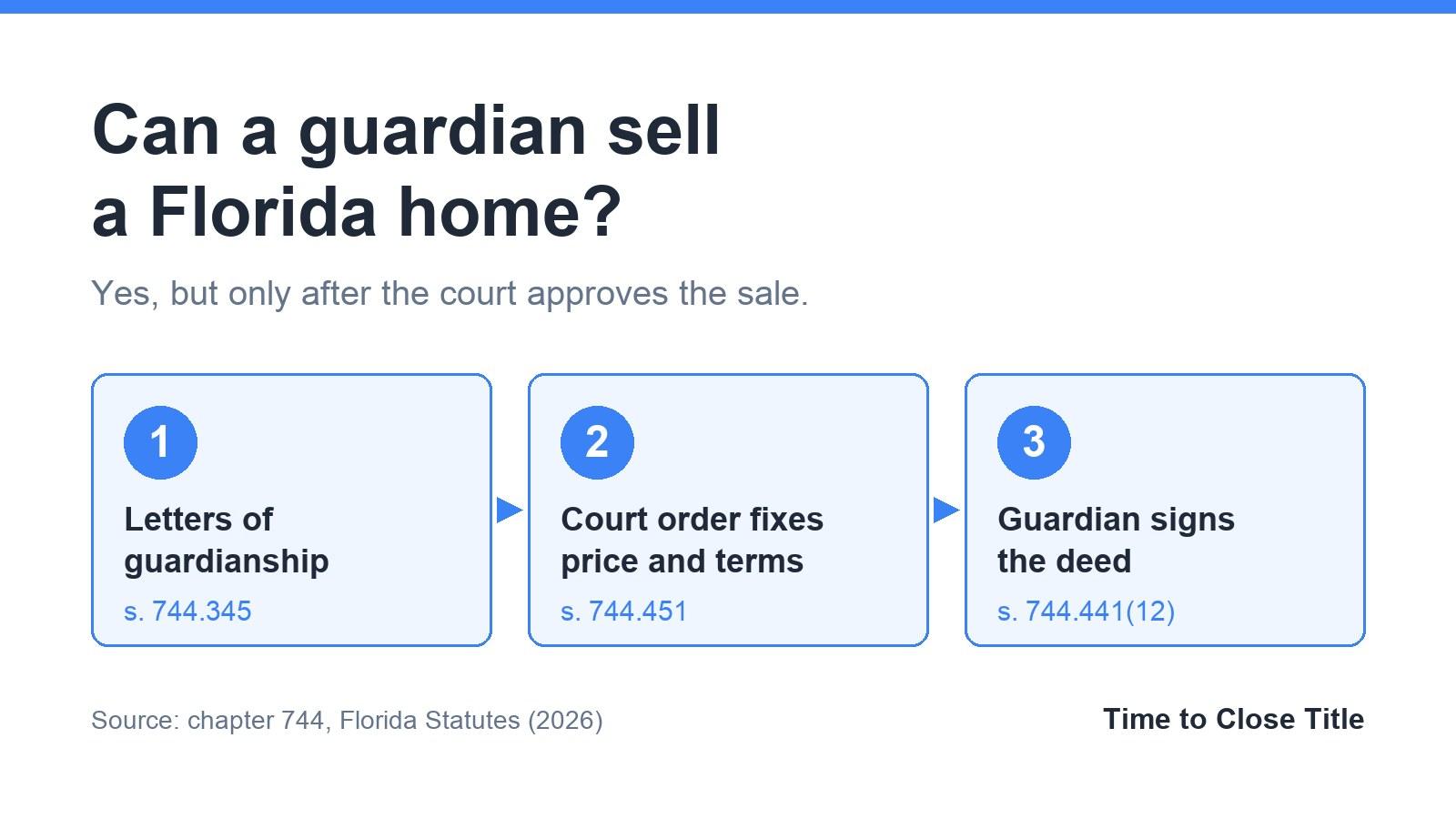
Yes. A guardian can sell a Florida home only after the court approves it. Under section 744.441(12), Florida Statutes, a guardian of the property may sell the ward's real estate, including homestead, once the court grants a petition; under section 744.451 the order describes the property and fixes the price and terms of a private sale.
Key takeaways
- Section 744.441(12) lets a plenary guardian of the property, or a limited guardian with that power, sell, mortgage, or lease the ward's real property, including homestead, but only after court approval on a petition.
- Under section 744.447, the petition states why the sale is needed, describes the property, and gives the price and terms; notice generally goes to the ward and next of kin unless the court waives it.
- Under section 744.451, an order for a private sale fixes the price and the terms, so a renegotiated contract may need to go back to the court.
- Letters of guardianship under section 744.345 say whether the guardian covers the property and whether the guardianship is plenary or limited; a guardian of the person only cannot sign a deed.
- A filed incapacity or guardian advocate proceeding can suspend a power of attorney under section 709.2109(3), and entireties property needs the other spouse to join under section 744.457.
- This article is general information, not legal advice. The guardian's attorney handles the court petition and the order.
Can a guardian sell a Florida home without a court order?
No. A guardian of the property needs the court's approval before selling the ward's real estate. Section 744.441, Florida Statutes, lists the powers a guardian may use only after obtaining court approval on a petition for authorization to act. Subsection (12) of that list is the power to sell, mortgage, or lease any real or personal property of the estate, including homestead property, for cash, credit, or both.
The power belongs to a plenary guardian of the property, or to a limited guardian of the property within the powers the appointing order or an approved guardianship report gives. Being the ward's child, spouse, or caregiver does not by itself give anyone the right to sign a deed. The court order does.
The ward's own signature is usually not the answer either. Under section 744.3215(3), the rights a court may remove from a person found incapacitated and delegate to the guardian include the right to contract and the right to manage property or make any gift or disposition of property. When those rights have been removed, the ward cannot sign the contract or the deed alone.
What do letters of guardianship show the title company?
Who the guardian is and what the guardian may do. Under section 744.345, letters of guardianship must say whether the guardianship covers the person, the property, or both, and whether it is plenary or limited. If it is limited, the letters must list the guardian's powers and duties.
That distinction decides whether the guardian can sell at all. A guardian of the person makes personal decisions for the ward but is not, from that appointment alone, the person who manages and sells the ward's property. When we open a file, we read the letters first to confirm the seller named on the contract is a guardian of the property with the power to sell real estate.
| Document | What it shows | Where it comes from |
|---|---|---|
| Letters of guardianship | Person, property, or both; plenary or limited; the guardian's powers | s. 744.345 |
| Petition for authorization to act | Why the sale is needed, the property, and the price and terms | s. 744.447 |
| Order authorizing the sale | The property described, and for a private sale the price and terms | s. 744.451 |
| Spouse's joinder, if entireties property | The spouse who is not incapacitated joins the conveyance | s. 744.457(1)(a) |
| Deed signed by the guardian | Conveys the ward's interest under the court's authority | s. 744.441(12) |
What goes into the petition and the court order?
The facts, the property, and the deal. Under section 744.447(1), the petition states the facts showing the expediency or necessity of the sale, describes the property, and gives the price and terms. It must also say whether it conforms to the general terms of the guardianship report and whether the ward has been adjudicated incapacitated as to the rights involved.
Notice is part of the process. Under section 744.447(2), notice of the petition goes to the ward, to the next of kin, and to interested persons who have filed requests for notices, unless the court waives it. Notice need not be given to a ward under 14 years of age or one who has been determined to be totally incapacitated.
Under section 744.451, the order authorizing a sale describes the property. For a private sale, the order fixes the price and the terms. For a public sale, it says the property goes to the highest bidder and the court reserves the right to reject all bids.
Because a private-sale order fixes the price and terms, a contract that changes after inspections, appraisal, or a repair negotiation may no longer match the order. Whether to ask the court to amend or confirm it is the guardian's attorney's decision. We compare the order with the final contract and settlement statement and flag any difference before closing.
What if the home is homestead or owned with a spouse?
Homestead can be sold through the guardianship too, but the same court approval applies. Section 744.441(12) expressly includes homestead property in the guardian's power to sell, mortgage, or lease, after court approval. Our guide to why both spouses sign on Florida homestead explains the joinder rule that applies to married owners in general.
Property owned by a married couple as tenants by the entirety follows its own section. Under section 744.457(1)(a), entireties property of an incapacitated person with a guardian of the property may be sold in accordance with section 744.447 if the spouse who is not incapacitated joins in the sale. If both spouses are incapacitated, the guardians alone convey, in one instrument or separate ones.
Under section 744.457(1)(b), when the court approves the sale of entireties or joint-with-survivorship property, it may direct that half the net proceeds go to the guardian of the ward and half to the spouse, or that the proceeds keep the same survivorship character as the original asset. How the proceeds are split is set by the order, not by us. Read how to take title in Florida for how those forms of ownership work.
What about a power of attorney, or property owned by a minor?
A durable power of attorney can avoid a guardianship, but a pending guardianship case can pause it. Under section 709.2109(3), if anyone starts a court proceeding to determine the principal's incapacity or to appoint a guardian advocate, the agent's authority is suspended until the petition is dismissed or withdrawn or the court authorizes the agent to act. If the agent is the principal's parent, spouse, child, or grandchild, the authority is not suspended unless a verified motion under section 744.3203 is also filed. Under section 709.2109(1)(c), a power of attorney terminates when the principal is adjudicated totally or partially incapacitated, unless the court keeps certain authority in place.
That is why we ask, on every power of attorney closing, whether any incapacity or guardianship case has been filed. A case filed after the contract is signed can change who is allowed to sign the deed.
Minors are a separate case. Under section 744.301(2), parents as natural guardians may, without appointment, authority, or bond, collect, manage, and dispose of real or personal property distributed to their minor child from an estate or trust, but only when the amounts received in the aggregate do not exceed $15,000. Above that, the shortcut in that subsection does not apply, and the family's attorney decides whether a guardianship of the property is needed before a sale. A child who inherits a share of a house often comes up in estate sales.
$15,000
Aggregate limit for a natural guardian acting without appointment, s. 744.301(2)
Under 14
Age below which the ward need not get notice of the petition, s. 744.447(2)
1/2
Share of net proceeds the court may direct to the ward's guardian on an entireties sale, s. 744.457(1)(b)
How does the title company close a Florida guardianship sale?
We treat the court file as part of the chain of title. The title search shows who holds record title, and the commitment lists what must be recorded or produced before the policy issues. On a guardianship sale that usually means the letters and the order authorizing the sale, and the underwriter decides what form it needs them in.
For a home in Hernando County, the deed from the guardian is recorded in the county's official records like any other deed, and the court documents the underwriter requires go with it. Documentary stamp tax on the deed is figured the usual way; see our guide to Florida documentary stamp tax on deeds.
We do not file guardianship petitions, decide whether a sale is in the ward's best interest, or tell the court what price to approve. The guardian's attorney handles the case, and the judge decides.
Confirm the guardian's authority
Read the letters of guardianship to confirm a guardian of the property, plenary or limited with power over real estate, under section 744.345.
Sign a contract subject to court approval
The guardian signs the purchase contract, and the guardian's attorney petitions the court under section 744.447 with the price and terms.
Get the order
The court enters an order under section 744.451 describing the property and, for a private sale, fixing the price and terms.
Match the order to the deal
The title company compares the order with the final contract and settlement statement and flags any change in price or terms.
Close and record
The guardian signs the deed under section 744.441(12), a non-incapacitated spouse joins for entireties property under section 744.457, and the deed is recorded with the documents the underwriter requires.
Frequently asked questions
Does a guardian need court approval to sell a house in Florida?
Yes. Section 744.441(12), Florida Statutes, lets a guardian of the property sell the ward's real property, including homestead, only after the court approves a petition for authorization to act.
Can the sale price change after the court approves it?
For a private sale, section 744.451 says the order fixes the price and terms. If the deal changes, the guardian's attorney decides whether to go back to the court before closing.
Can a guardian of the person sign the deed?
Not from that appointment alone. Section 744.345 requires the letters to say whether the guardianship covers the person, the property, or both. The deed is signed by a guardian of the property with the power to sell.
Does a power of attorney still work once a guardianship case is filed?
Often not. Under section 709.2109(3), filing a proceeding to determine incapacity or appoint a guardian advocate suspends the agent's authority until the court acts, except that an agent who is the principal's parent, spouse, child, or grandchild is suspended only if a verified motion under section 744.3203 is also filed.
Does Time to Close Title handle the guardianship court filing?
No. We search the title, review the letters and the order with the underwriter, and close the sale. The guardian's attorney files the petition and handles the court case.