Title Insurance
What Is a Quiet Title Action in Florida?
Direct answer
A quiet title action in Florida is a lawsuit asking a circuit court to declare who owns the property and to remove a cloud, like a defective deed or adverse claim, under chapter 65, Florida Statutes. A recorded final judgment can vest title, so a title insurer can rely on it. An attorney files it; the title company does not.
Key takeaways
- Section 65.021 lets a person claiming legal or equitable title, whether in possession or not, sue to quiet title or remove a cloud created by an adverse claim.
- Section 65.061 covers clouds such as defective execution, missing witnesses, defective acknowledgments, and adverse possession that has ripened into title, and the case may be filed in any county where part of the land lies.
- The plaintiff generally has to trace title from the original source or for at least 7 years before filing, unless the court directs otherwise; a tax deed case under section 65.081 does not need to go back past the tax deed.
- A recorded final judgment under section 65.061(5) operates to vest title, but a person who was not made a party is not bound by it under section 65.041.
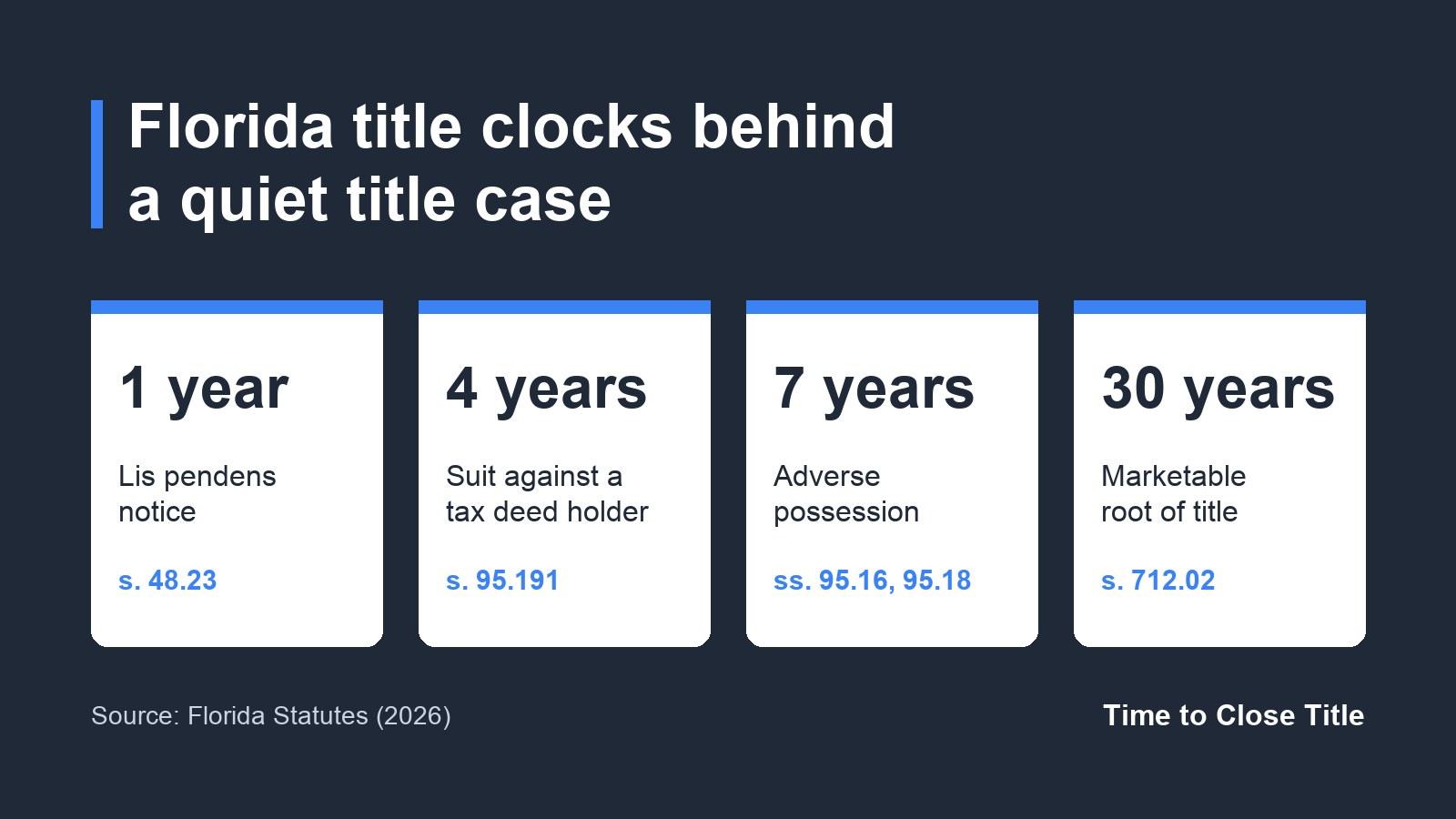
- Some claims age out on their own clocks: 1 year for most lis pendens notices, 4 years for suits against a tax deed holder in possession, 7 years for adverse possession, and 30 years under the Marketable Record Title Act.
- This article is general information, not legal advice. Talk to a Florida real estate attorney before you file or defend a quiet title action.
What is a quiet title action in Florida?
It is a lawsuit that asks the court to settle who owns a piece of land and to remove a cloud on the title. A cloud is a recorded document or claim that looks like it gives someone else an interest, even if the owner believes it is invalid. A buyer, a lender, and a title insurer all read the public record, so a cloud can stop a sale even when everyone agrees it is wrong.
Chapter 65, Florida Statutes, gives the court that power. Under section 65.021, any person or company claiming legal or equitable title, whether in actual possession or not, can sue a person not in possession who has an adverse claim, to determine that claim and quiet or remove the cloud. The statute adds that it is no bar that the adverse claim is void on its face.
Under section 65.011, the court can determine the plaintiff's title, enter judgment quieting title and awarding possession, and issue injunctions where needed. The result is a court judgment that later buyers and insurers can rely on instead of the owner's word.
When does a Florida title need a quiet title action?
When the person who could fix the problem with a signature is gone, unknown, or unwilling. Most items on a title commitment are cleared without a lawsuit: a payoff and a satisfaction, a release, or a new deed. A misspelled name or a wrong lot number can often be fixed by a corrective deed if the original grantor is available to sign it.
Section 65.061(2) lists the kinds of clouds a court can cancel. They include an instrument with defective execution, omitted seals, a lack of witnesses, or a defective acknowledgment, and a claim of adverse possession that has ripened into good title. The action may be filed in any county where any part of the land is located.
Tax deeds are a common reason too. Under section 65.081, the grantee of a tax deed, or a successor, can sue to quiet title against the former record owner and others claiming an interest. Our guide to title insurance on a Florida tax deed covers that route in detail.
| Problem found in the search | Usual route | Where it comes from |
|---|---|---|
| Misspelled name or wrong legal description, grantor available | Corrective deed signed by the original grantor | The parties, not a court |
| Deed missing a witness or with a defective acknowledgment | Quiet title action to cancel or confirm the instrument | s. 65.061(2) |
| Tax deed buyer wants an insurable title | Quiet title action, or the 4-year period passing | ss. 65.081, 95.191 |
| Claim of title by long possession | Quiet title action after 7 years of qualifying possession | ss. 95.16, 95.18, 65.061(2) |
| Pending lawsuit recorded against the land | Dismissal, release, discharge, or expiration of the notice | s. 48.23 |
Who can file a quiet title action, and who has to be named?
The owner, and sometimes a prior owner. Under section 65.031, the action may be brought in the name of the owner or of any prior owner who warranted the title. A seller who gave a warranty deed may therefore have a reason to clear a defect that later surfaces. Lands with a common defect may be included in one action regardless of the number of owners, and under section 65.051 several people with the same adverse claim against them may join as plaintiffs.
Naming the right defendants matters as much as winning. Under section 65.041, a person who is not a party is not bound by a judgment against his or her interest. A judgment that leaves out an heir, a lienholder, or a spouse may not clear that person's claim, and a title insurer reading the file will notice.
Many plaintiffs also record a notice of lis pendens so the public record shows the case while it is pending. The rules for that notice, including when it expires, are in our guide to a lis pendens on a Florida title search. The attorney decides who to name and whether to record a notice. We do not.
What does the plaintiff have to prove in a Florida quiet title case?
A good chain of title, and a reason the cloud should go. Under section 65.061(3), the complaint must deraign title, meaning trace it, from the original source or for a period of at least 7 years before filing, unless the court directs otherwise. In a tax deed case, section 65.081(2) says the complaint does not need to deraign title beyond the issuance of the tax deed.
Under section 65.061(4), the court shall enter judgment removing the cloud if the plaintiff shows legal title or equitable ownership on one of the listed grounds, or if a default is entered. If a defendant is in actual possession, any party may demand a jury, and the court orders an ejectment issue tried to the jury under section 65.061(1).
Defenses can be narrow. In a tax deed case, section 65.081(3) allows no defense except that the former owner paid the taxes before the tax deed was issued. Outside tax deeds, the defenses depend on the facts, which is a question for the parties' attorneys.
Under section 65.061(5), a final judgment may be recorded in the county where the land lies and operates to vest title. Section 65.061(6) says the remedy is cumulative, so it does not replace other ways to clear title.
How long before a Florida title claim ages out on its own?
It depends on the claim, and a few clocks matter often. Under section 48.23(2), a notice of lis pendens is not effective beyond 1 year from the start of the action unless the relief sought is founded on a duly recorded instrument or a construction lien, or the court extends it. Time on appeal is not counted.
Under section 95.191, when a tax deed holder is in actual possession, a former owner or other adverse claimant must sue within 4 years after the holder went into possession. When someone else adversely possesses the land, the tax deed holder must sue within 4 years from the date of the deed.
Adverse possession takes 7 years of continued possession. Under section 95.16, possession under color of title relies on a written instrument, decree, or judgment, which must be recorded with the clerk for possession that began after 1945. Under section 95.18, possession without color of title also requires paying the outstanding taxes within 1 year after entering possession and filing a return with the property appraiser within 30 days after that. Section 95.18 also says that occupying a residential structure solely on that claim before the return is made is trespass.
The longest clock is the Marketable Record Title Act. Under section 712.02, an owner vested with an estate of record for 30 years or more has marketable record title free of most older claims, subject to the exceptions in section 712.03. Our guide to how far back a Florida title search goes explains what survives.
1 year
Most lis pendens notices expire, s. 48.23(2)
4 years
Suits against a tax deed holder in possession, s. 95.191
7 years
Adverse possession, ss. 95.16 and 95.18; minimum deraignment, s. 65.061(3)
30 years
Marketable record title, s. 712.02
What does the title company do with a Florida quiet title judgment?
We read it, and the underwriter decides whether it clears the requirement. A title search shows the cloud in the first place. When a requirement on the commitment calls for a quiet title judgment, we review the recorded final judgment, the parties named, and the land described, and compare them with the cloud in the record. Whether the judgment is enough to insure without an exception is the title insurer's call, made file by file.
For a property in Hernando County, the judgment is recorded in the county's official records like a deed, and it then becomes part of the chain of title that future searches read. If the court has not yet ruled, the file usually waits, or the buyer and seller decide whether to change the contract.
Court costs are separate from the closing. Section 28.241 sets circuit court filing fees; for real property actions it uses a schedule from $395 to $1,900 based on the value of the claim, and the clerk decides which fee applies. Attorney's fees and service of process are on top of that.
We do not file quiet title actions, give legal advice about whether to sue, or predict how a court will rule. A Florida real estate attorney handles the case.
Find the cloud
The title search and commitment identify the recorded instrument or claim that clouds the title.
Try the simple cure first
A release, satisfaction, or corrective deed is used when the person who must sign is available and willing.
Ask the underwriter what it needs
The title insurer says whether it will require a quiet title judgment or accept another cure.
File through an attorney
The owner's attorney files under chapter 65, names every party with a claim, and traces the chain of title.
Record the judgment
The final judgment is recorded in the county where the land lies, and the title company reviews it against the requirement.
Frequently asked questions
How long does a quiet title action take in Florida?
There is no fixed time. It depends on how many defendants must be served, whether anyone contests the case, and the court's calendar. An uncontested case that ends in a default can move faster than one that goes to trial. Your attorney can estimate the timeline.
Can I quiet title without being in possession of the property?
Yes. Section 65.021 allows a person claiming legal or equitable title to sue whether in actual possession or not. Section 65.081 says the same for an action based on a tax deed.
Does a quiet title judgment bind everyone?
No. Under section 65.041, a person who was not a party is not bound by a judgment against his or her interest. That is why the complaint should name every person who may have a claim.
Is a quiet title action required after buying a Florida tax deed?
Not by statute, but a title insurer may require one before it issues a policy. Under section 95.191, claims against a tax deed holder in actual possession must generally be brought within 4 years, which some insurers weigh instead of a judgment.
Does Time to Close Title file quiet title actions?
No. We search the title, list the requirement on the commitment, and review the recorded judgment with the underwriter. A Florida real estate attorney files and handles the lawsuit.