Title Insurance
What a Florida Title Gap Exception Is
Direct answer
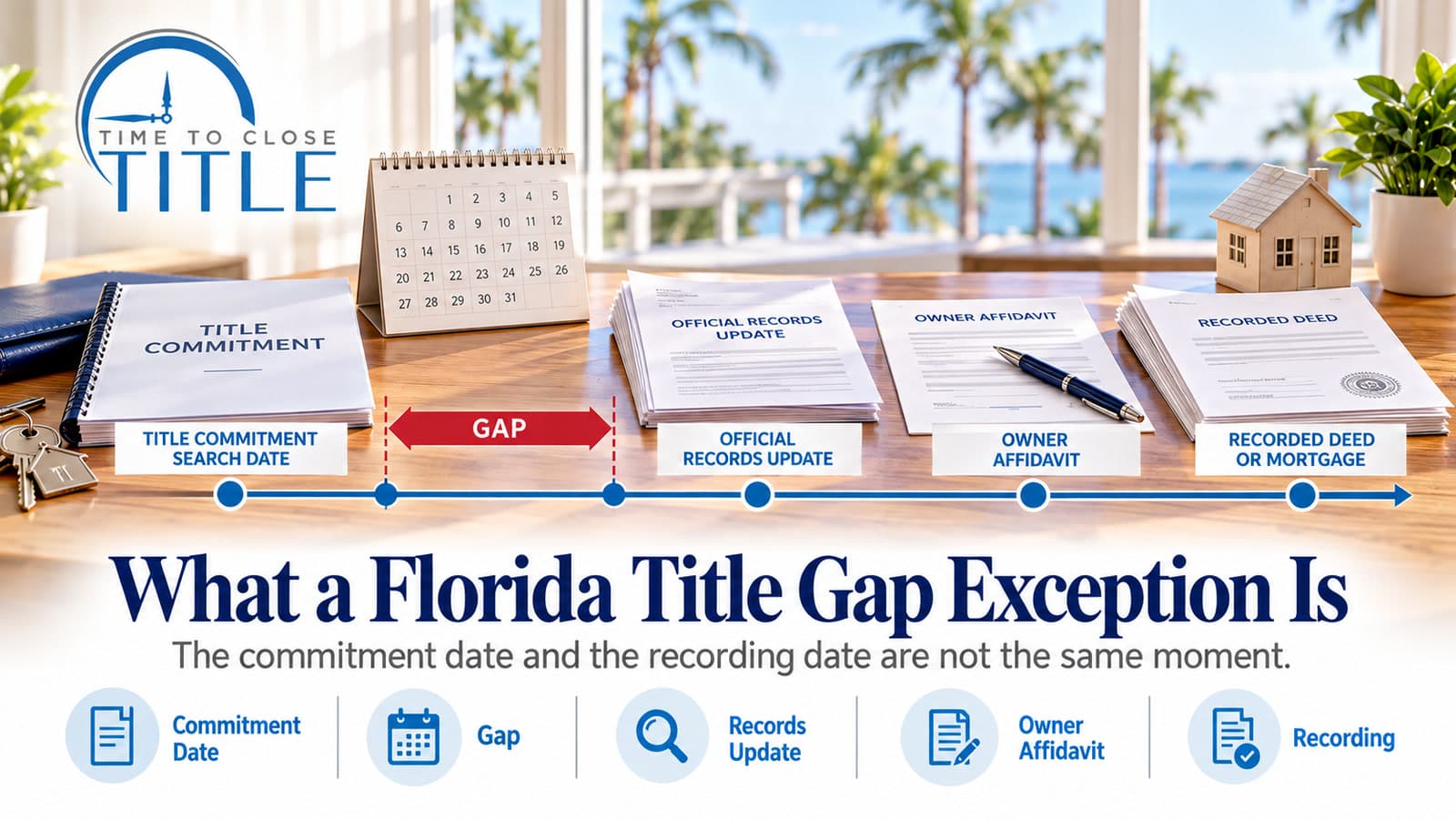
A Florida title gap is the time between the date on the title commitment and the recording of the deed or mortgage. The commitment excepts defects that first show up in the public records, or that are created, during that interval. Under section 695.01, a deed or mortgage is not good against later creditors and purchasers for value without notice unless it is recorded, so a lien recorded in the gap can come ahead of an unrecorded deed. Insuring the gap, sometimes called a gap endorsement, means that exception is not left on the policy when we have updated the Official Records, the seller has signed an affidavit that nothing new has affected the title, and we record after funding. It does not clear a lien the update actually finds, and it does not remove an open notice of commencement. On a closing we handle, we record after good funds. A quitclaim we only prepare is recorded by the client.
Key takeaways
- The commitment date is the end of the search, not the day the deed is recorded.
- A lien recorded in that interval can come ahead of a deed that is not yet of record.
- Insuring the gap means the policy does not keep that exception when the update and the affidavit are clean.
- A new lien on the update, or work disclosed on the affidavit, still has to be cleared or excepted.
- An open notice of commencement is not removed by insuring the gap.
What is the gap on a Florida title commitment?
The title search stops on a date. That date is printed on the commitment. The deed and the mortgage are recorded later, after signing and after the buyer's funds are in. The days, or the hours, between those two moments are the gap. A judgment, a mortgage, or a claim of lien can be recorded in that window and still be ahead of a deed that has been signed but not yet recorded.
Section 695.01 is why the window matters. A deed or mortgage is not good against later creditors and purchasers for value without notice unless it is recorded. Signing at the table is not that recording. Read what gets recorded after closing. The public website is not always same-day. We do not publish a county's posting time.
| What it is | What it does not do | |
|---|---|---|
| Commitment | The search report, dated when the records were read | It is not the policy, and it excepts anything new after its date |
| The gap | The time after that date and before our deed or mortgage is recorded | A signed deed that is still in a folder has not closed the gap |
| Insuring the gap | The policy we issue as of recording, when the update and the affidavit are clean | It does not erase a lien the update finds |
| A lien in the gap | A mortgage, judgment, or claim recorded before our instrument | It is not cured by a phone call that nothing has changed |
What does a gap endorsement actually cover?
People call it a gap endorsement. On a file we insure, it is not a second policy and not a price we quote in this article. It means the commitment's gap exception is not carried onto the owner's policy or the lender's policy. We update the Official Records before we record. The owner signs an affidavit that, since the commitment date, they have not signed a new mortgage, started work that could support a construction lien, or done anything else that affects the title, except what the affidavit discloses. If that update and that affidavit are clean, the policy we issue is as of recording.
If the update shows a new lien, that lien is cleared or it stays an exception. We do not delete the gap exception because the closing is on the calendar. Read what title insurance does not cover. Items already listed on Schedule B stay excepted. A cash closing has the same gap. The absence of a lender does not record the deed. A refinance has the same gap on the new mortgage until that mortgage is recorded.
Search date
The commitment stops there. Later recordings are not in that report.
The update
We read the Official Records again before we record.
The affidavit
The owner swears nothing new has affected the title, or they disclose what has.
What still has to be cleared even if we insure the gap?
An open notice of commencement is already a recorded fact. Insuring the gap does not release it, and it does not turn a claim of lien into a payoff. Read new construction closings. If the affidavit says work started, or materials were delivered, we treat that disclosure as a title item. We do not insure over it on a guess.
A municipal or utility search has its own through date. Updating the Official Records is not a new municipal lien search. A dry closing, where the papers are signed and the money is not yet in, leaves the deed unrecorded. The gap stays open until we can record. If an agent is signing for the owner, that agent cannot make an affidavit of the owner's personal knowledge. Read power of attorney at a Florida closing.
How does the gap get closed on a file we insure?
We read the commitment date when the file opens, not the morning of signing. The seller, or the borrower on a refinance, signs the affidavit at closing. We update the record, fund, and then submit the deed or mortgage for recording in the county where the land sits. That recording is what ends the interval the commitment had excepted. The policy follows that recording. It is not handed across the table with the keys.
On a sale or refinance we close, we record after good funds. A quitclaim we only prepare, with no insured closing, is recorded by the client, and we do not treat that prepare-only deed as a policy we have issued. Confirm wiring instructions by calling (352) 792-1214.
Read the commitment date
That date is the end of the first search. Send the contract early enough for the search to start.
Clear what is already listed
Payoffs, releases, and Schedule B items are separate from the gap. The gap does not erase them.
Update the Official Records
We look again for anything recorded after the commitment date and before we record.
Take the owner's affidavit
The owner discloses any new mortgage, work, or other matter since the commitment date. A verbal assurance is not the affidavit.
Fund, then record
On a closing we handle, we record the deed or mortgage after good funds. The policy is issued as of that recording when the update and the affidavit are clean.
Frequently asked questions
Is a gap exception the same as a lien?
No. The exception is the commitment saying it does not cover matters that arise after the search date. A lien is one of the things that can be recorded in that window. The exception is the warning. The lien is the document.
Does the owner's policy automatically cover the gap?
On a closing we insure, the policy is issued as of recording when we have updated the Official Records and the owner's affidavit is clean. The commitment itself still has the exception. A commitment is not the policy. We do not delete the exception if the update or the affidavit shows a new matter.
Why does the seller sign an affidavit about the gap?
The records update shows what has been recorded. It does not show a mortgage the seller signed yesterday and has not recorded, or work that has started and has not become a claim of lien yet. The affidavit is that disclosure. We do not accept a text that says nothing has changed.
What if a judgment is recorded the day before closing?
The update should find it. It has to be paid, released, or excepted. Insuring the gap does not skip a lien that is already of record. Tell us as soon as you know about a new case. Do not wait for the signing.
Does a cash purchase skip the gap?
No. Cash can close faster, and it still has a commitment date and a recording date. The owner's policy is the buyer's coverage. There is no lender's policy forcing the issue, which is why the owner's policy matters on a cash file.
Does insuring the gap release a notice of commencement?
No. An open notice of commencement stays a title item until it is handled the way the construction file requires. A claim of lien recorded in the gap is the same kind of problem. Read new construction closings.
When does the gap actually end?
When the deed or mortgage is recorded, on a closing we handle, after good funds are in. Signing does not end it. A quitclaim we only prepare is recorded by the client. Call (352) 792-1214 or contact us. The office is at 3087 Anderson Snow Road, Spring Hill, FL 34609.