Title Insurance
Clearing a Judgment, Tax Lien, or Old Mortgage in Florida
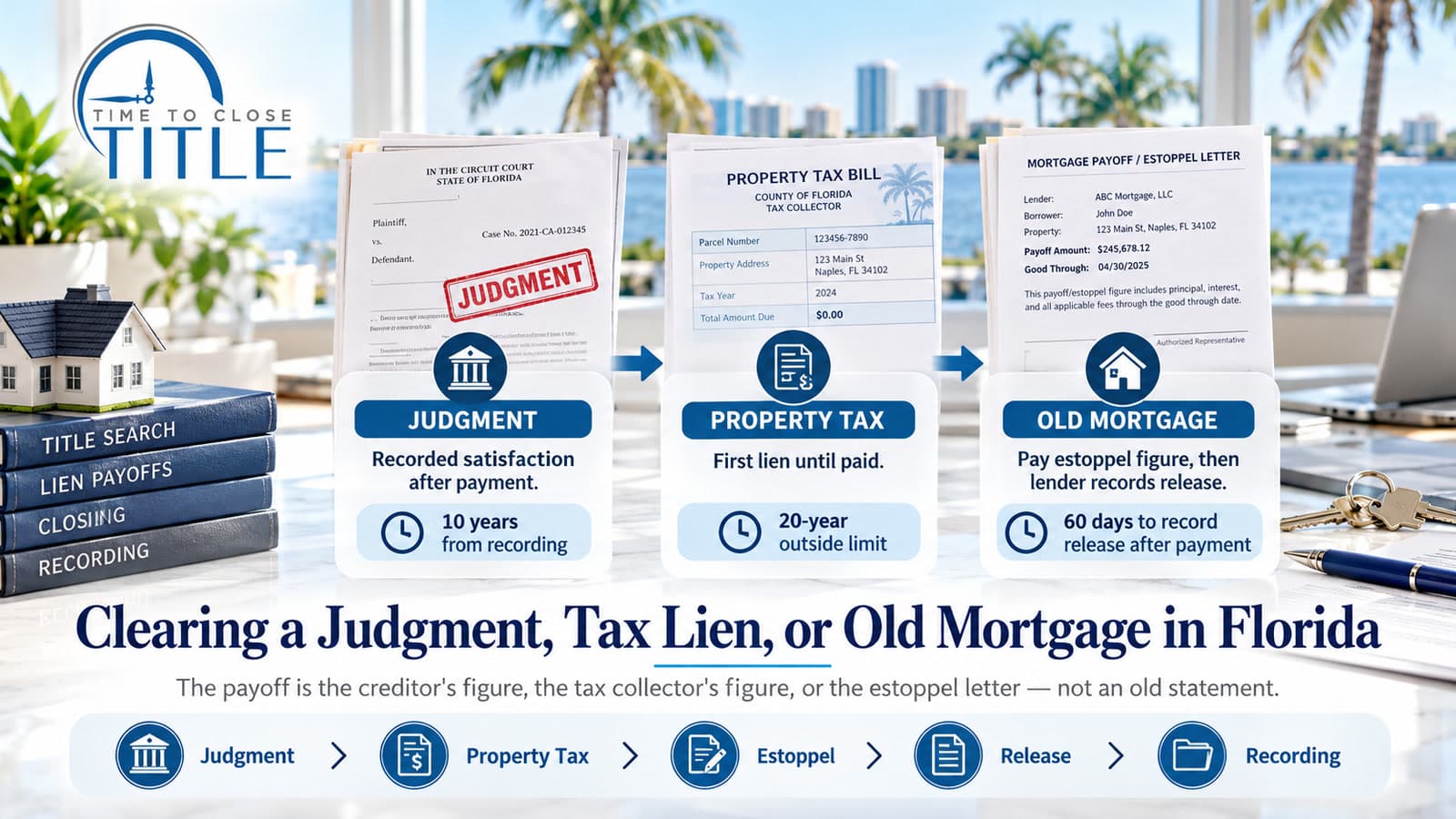
Direct answer
A Florida closing cannot ignore a recorded judgment, unpaid property taxes, or a mortgage that is still open in the Official Records. A judgment becomes a lien on real property in a county when a certified copy is recorded there with the creditor's address. If that recording was on or after July 1, 1994, the initial lien lasts 10 years from recording, and it cannot run past 20 years from the date the judgment was entered. Property taxes are a first lien from January 1 of the year they are levied until they are paid. A mortgage is cleared by the payoff on a written estoppel letter, and the lender then has 60 days to record the release. Time to Close Title orders those figures and pays the amount the creditor or the tax collector states. We do not invent the payoff, and we do not decide that a judgment has expired. On a sale we close, we record the deed after funding.
Key takeaways
- A judgment is a lien on the land only after a certified copy is recorded in that county with the creditor's address.
- The initial lien is 10 years from that recording, and it cannot extend past 20 years from the date the judgment was entered.
- Property taxes are a first lien from January 1 of the levy year until they are paid.
- The mortgage payoff is the estoppel letter. The lender has 60 days after payment to record the release.
- We pay the figure we are given. We do not negotiate it, and a seller's old statement is not the estoppel.
Which of these three items actually has to be cleared?
The title search lists what is already of record. An open mortgage, a recorded judgment, and unpaid property taxes are three different creditors. Paying one does not release the other. A municipal lien is a fourth item, from the city or the utility, and it is not the property-tax bill.
A judgment or a mortgage recorded after the commitment date is the gap, not an item the first search already cleared. Read what a title gap exception is. Tell us about a new case when you learn of it. Do not wait for the signing.
| Item | What makes it a lien | What clears it |
|---|---|---|
| Judgment | A certified copy recorded in that county, with the creditor's address | A recorded satisfaction after payment, or a transfer of the lien off the property |
| Property tax | A first lien from January 1 of the year the tax was levied | Payment to the tax collector. A mortgage release does not pay the tax |
| Mortgage | The recorded mortgage, until a release is recorded | Payment of the estoppel figure, then the lender's recorded release |
| What we do not use | A coupon, a verbal balance, or last year's statement | Those are not the estoppel, the tax bill, or the judgment payoff |
When is a Florida judgment a lien on the house?
Under § 55.10, a judgment, order, or decree becomes a lien on real property in a county when a certified copy is recorded in that county's official records, and only if the judgment contains the creditor's address or an affidavit with that address is recorded at the same time. A certified copy recorded on or after July 1, 1994, is a lien for an initial 10 years from the recording. It can be extended for another 10 years by rerecording a certified copy before it expires, together with an affidavit of the creditor's current address. Section 55.081 stops the lien 20 years after the judgment was entered, or sooner if it is satisfied. We do not decide that an old judgment has expired. The file has to show the dates.
Section 701.04(3) gives the creditor, or the attorney of record on a judgment, 60 days after full payment to sign a satisfaction, send it for recording, and send the recorded satisfaction to the person who paid. We collect the amount that creditor states. We do not negotiate the number. The owner can also transfer the lien off the property onto a cash deposit or a surety bond under § 55.10(5). That deposit or bond has to equal the amount demanded, plus interest at the legal rate for 3 years, plus $500. The clerk's certificate of transfer has a statutory service charge of up to $15, and up to $7.50 more for each additional lien. We do not file that transfer, and we do not choose the bond. We also do not drop a recorded judgment because the seller says the house is homestead.
10 years
Initial lien if the certified copy was recorded on or after July 1, 1994.
20 years
Outside limit, measured from the day the judgment was entered.
60 days
After full payment, for the creditor to record the satisfaction.
How are property taxes and an old mortgage actually paid off?
Section 197.122 makes property taxes a first lien, ahead of other liens, from January 1 of the year they are levied until they are paid or barred. Owners are responsible for paying current and delinquent taxes before April 1 of the year after the year the taxes were assessed. We get the open amount from the tax collector. We do not calculate penalties, and we do not decide a proration the contract does not state. A tax certificate is a later step under that same chapter. It is not cleared by a mortgage satisfaction, and a lien from a tax certificate is enforced only the way chapter 197 allows. We do not redeem it from a blog post.
A mortgage payoff is an estoppel letter under § 701.04. Within 10 days after receiving a proper written request, the servicer sends the unpaid balance, itemized, and the per-day interest. A request by mail is not received the day it is dropped in a box. We pay the estoppel figure the file is entitled to rely on. If a corrected letter arrives by 3 p.m. at least one business day before that payment, the correction controls. A seller's coupon does not. Within 60 days after payment, the servicer must sign a release, send it for recording, and send the recorded release to the owner. The release does not wipe any personal liability that was left on the note. A mortgage that was paid years ago and never released is still open until that release is recorded. The 60 days have already run. We still need the release before we can insure past it. If a foreclosure lis pendens or a bankruptcy is of record, tell us the first day. We do not close through that case, and we do not calculate a deficiency.
What should you send so the payoff does not wait until the week of closing?
Send the lender's name, the loan number, and a current statement with the contract. Send any judgment case name you know about. The statement tells us where to ask. It is not the amount we pay. The estoppel, the tax collector, and the judgment creditor each state their own figure. Those amounts come out of the closing funds when they are owed. Read what gets recorded after a Florida closing. The deed records after funding. The satisfaction is the creditor's document, and the statute gives that creditor 60 days after payment to record it.
On a sale we close, we record the deed after good funds, in the county where the land sits. A quitclaim we only prepare, with no sale closing, is recorded by the client, and a prepare-only deed does not include these payoffs. Call (352) 792-1214 to confirm any wiring instructions.
Send the loan and any case you know about
Lender name, loan number, and a current statement. A judgment needs the case, not a guess at the balance.
We order each figure
The estoppel, the tax collector, and the judgment creditor each state their own amount.
Match the letter to the file
A corrected estoppel that arrives in time replaces the first one. An old coupon does not.
Pay that figure from the closing funds
We do not negotiate the number, and we do not insure over an open item that has not been paid or released.
Record the deed, and follow the release
On a sale we close, we record the deed after funding. The creditor has 60 days after payment to record the satisfaction.
Frequently asked questions
Does a mortgage disappear from the record when it is paid off?
No. Payment is the estoppel figure. The recorded release is a second step. Section 701.04 gives the servicer 60 days after payment to sign that release and send it for recording. A mortgage paid years ago is still open if the release was never recorded.
How long does a Florida judgment stay a lien on the house?
If the certified copy was recorded in that county on or after July 1, 1994, with the creditor's address, the initial lien is 10 years from recording. It can be extended, and it cannot run past 20 years from the day the judgment was entered. We do not decide that one has expired. The recording dates have to be in the file.
Do property taxes come ahead of the mortgage?
Yes. Section 197.122 makes the taxes a first lien from January 1 of the year they were levied until they are paid. Owners are responsible for paying them before April 1 of the following year. We use the tax collector's figure. We do not calculate penalties.
Is a tax certificate the same thing as the tax bill?
No. The tax bill is the amount assessed. A tax certificate is a later step under chapter 197, and that lien is enforced only the way that chapter allows. A mortgage satisfaction does not pay either one. We do not redeem a certificate from this article.
Can the seller's statement be used as the payoff?
No. The mortgage payoff is the estoppel letter. The judgment payoff is the creditor's figure. The tax payoff is the tax collector's figure. A coupon, a text, or last year's statement tells us who to ask. It is not the amount.
Can you close if the satisfaction will be recorded after the deed?
The deed can record after we pay the estoppel figure. The lender still has 60 days to record the release. We do not treat a same-afternoon posting as the requirement. A mortgage that was paid years ago and never released is different. That release has to be in hand before we insure past it.
Who records the deed if there is a payoff?
On a sale we close, we record the deed after funding, in the county where the land sits. The creditor records the satisfaction. A quitclaim we only prepare is recorded by the client. Call (352) 792-1214 or contact us. The office is at 3087 Anderson Snow Road, Spring Hill, FL 34609.